ما هو هذا المشروع؟
Introduction
Cerebral palsy (CP) is the most common motor disability of childhood. The gait impairments that characterize it originate from altered neuromuscular control and result in a walking pattern that is visibly different from the typical one.
To study how the nervous system organizes movement, research has long used muscle synergy analysis: a small number of activation patterns, shared across several muscles, through which the brain simplifies a complex task such as walking. Until now, this analysis has relied almost exclusively on electromyographic (EMG) signals — the electrical activity of the muscles — a limitation, since it describes how muscles activate but not how that activation translates into the actual movement of the joints.
A more recent model, kinematic-muscular synergies, combines EMG signals with joint kinematic data, directly linking the neural command to its biomechanical outcome. It had already been applied to the gait of healthy adults; the study presented here, conducted by Prof. Nicola Portinaro’s group together with researchers from CNR (STIIMA Institute), applies it for the first time to a pediatric population with cerebral palsy, to understand how this coupling changes with age.
Materials and methods
The study was conducted at the Movement Analysis Laboratory of Humanitas Research Hospital (Rozzano, Milan), in collaboration with the Italian Council of National Research.
This is a cross-sectional study: it does not follow the same children as they grow, but compares different groups of participants of different ages, each assessed in a single session.
Seventeen children and young people with cerebral palsy took part, divided into three age groups:
- Children (6–11 years): mean age 8.6 years;
- Adolescents (12–15 years): mean age 13.7 years;
- Young adults (16–20 years): mean age 17.4 years.
As a reference, a group of 22 typically developing children was used, all male, mean age 9 years: a single comparison group, closer in age to the youngest participants with cerebral palsy than to the oldest.
Each participant walked barefoot along a 5-metre walkway at a self-selected, comfortable speed. Movement was recorded with an 8-camera optoelectronic system synchronized with a force platform, computing the sagittal-plane angular accelerations of the pelvis, hip, knee and ankle. At the same time, the activity of 8 muscles per limb (tibialis anterior, medial and lateral gastrocnemius, rectus femoris, semitendinosus, biceps femoris, adductor magnus, gluteus maximus) was recorded with surface electrodes. The two types of data were combined and processed with a mathematical decomposition algorithm (mixed-matrix factorization), which extracts, for each limb, the kinematic-muscular synergies shared across the recorded steps.
Results
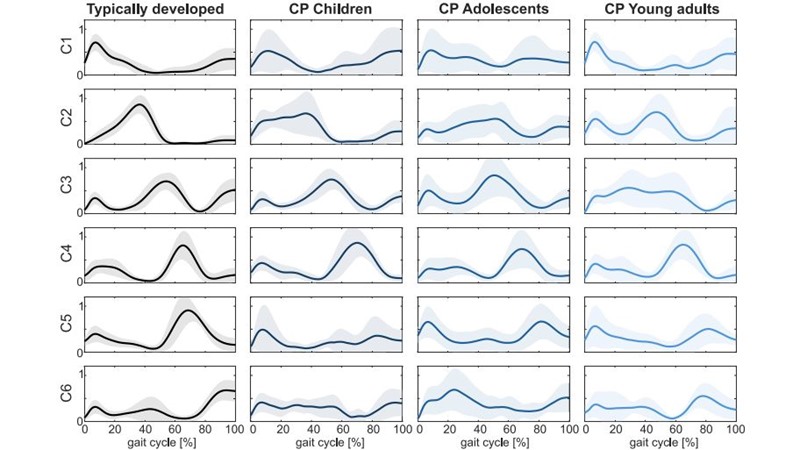
The results distinguish two aspects of synergies: their spatial structure (which muscles and joints work together) and their activation over time (when, during the step, each pattern comes into play).
Spatially, the structure was moderately preserved in all cerebral palsy groups compared with the reference group, without a clear worsening linked to age — even in young adults it remained comparable to that of the youngest children. What did change was the internal consistency within each group, i.e. how similar subjects in the same group were to one another: higher in children with cerebral palsy, significantly lower in adolescents (p = 0.04) and young adults (p = 0.001). Another age-related signal: in the older groups, muscles tended to co-activate more, with reduced selectivity of muscle recruitment.
Over time, the divergence with age was clearer: the average correlation between each group’s activation pattern and that of the reference group decreased from 0.70 in children with cerebral palsy, to 0.57 in adolescents, to 0.51 in young adults. Here too, typically developing children showed a much more consistent and repeatable activation pattern than all cerebral palsy groups (p < 0.001). Notably, these changes were not linked to the degree of motor impairment (GMFCS and FMS scales), which was similar across the three groups: a sign that what changes with age is mainly how and when motor modules are recruited, rather than their basic availability.
In short: the underlying structure of motor control appears to be established early and remains relatively stable; it is mainly its coordination over time that progressively diverges in the older groups — a pattern the authors interpret as a possible sign of compensatory strategies, growth-related biomechanical changes, or an accumulation of selective motor control deficits, rather than as a stage of typical development.
Conclusions
The study shows that kinematic-muscular synergies make it possible to distinguish alterations affecting the structure of synergies from those affecting the timing of their activation, linking them to the biomechanical consequences observed during gait — a distinction that traditional muscle analysis alone does not capture.
The authors propose this as a starting point for more targeted gait assessment: it could provide useful indications for tailoring the goals and strategies of rehabilitation, surgical planning, and orthotic prescription, depending on which component — spatial or temporal — is more impaired in the individual patient. However, the study did not test whether using these synergies actually improves rehabilitation outcomes: this is a perspective still to be validated.
It should also be noted that this is a preliminary study, with small subgroups (5 children, 7 adolescents, 5 young adults) and a reference group made up only of males, younger than the full age range observed in patients; the distribution of cerebral palsy subtypes was also not even across groups. These results will need to be confirmed in larger, more balanced samples.
References
Brambilla C, Scano A, Beltrame G, Marino G, Piccinini L, Molinari Tosatti L, Portinaro N. Kinematic-muscular synergies describe coupled neuro-muscular control and biomechanics of locomotion in children with cerebral palsy. Journal of Electromyography and Kinesiology, 90:103191, 2026. https://doi.org/10.1016/j.jelekin.2026.103191