ما هو هذا المشروع؟
Introduction
Anterior cruciate ligament (ACL) tears induce a proinflammatory intra-articular environment. ACL injuries are among the primary risk factors for knee post-traumatic osteoarthritis (PTOA), a specific subtype of osteoarthritis (OA) that develops following joint injury and often affects younger and healthier individuals compared to those with idiopathic OA. The reported prevalence of PTOA following ACL injuries can reach as high as 87%. Adolescents and young adults participating in sports requiring pivoting and directional changes are particularly vulnerable.
Although ACL reconstruction is widely performed to restore joint stability and function, it does not consistently prevent the development of PTOA, whose incidence remains high.
The study investigates the role of prokineticin-2 (PK2), a novel inflammatory and pain mediator. Previous studies by the same group identified the presence of PK2 in the synovial fluid of patients with traumatic meniscal injuries, and demonstrated, in a preclinical model of OA in mice, a role of PK2 in the inflammatory and neuroinflammatory pathways involved in OA pathophysiology and pain. This study presents the first evidence that PK2 is present in the synovial fluid of patients with isolated ACL tears and combined ACL-meniscal injuries.
Materials and methods
The authors are affiliated with Fondazione IRCCS San Gerardo dei Tintori in Monza, the University of Milano-Bicocca, the University of Milan, Policlinico San Pietro in Ponte San Pietro and Fondazione IRCCS Ca’ Granda Ospedale Maggiore Policlinico in Milan, where Prof. Nicola Portinaro is Senior Consultant in Pediatric Neuro-Orthopedics. The study was approved by the Ethics Committee of Fondazione IRCCS San Gerardo dei Tintori.
This was an observational cohort study based on prospectively collected synovial fluid samples, with long-term clinical follow-up at a minimum of 5 years after arthroscopic treatment. The study population consisted of 40 patients aged 18 to 43, divided into two groups of 20:
- ACL group: isolated anterior cruciate ligament tears;
- ACL + M group: ACL tears and associated traumatic meniscal tears.
All patients were recruited from the emergency department, after diagnosis was made by a senior orthopedic surgeon including patient history, physical examination, MRI imaging and final arthroscopic visualization. Patients were excluded if they had previous surgical intervention or lesions in the index or contralateral knee, bone or ligament injuries, chondral damage of grade 2 or higher, arthritis or chronic inflammatory conditions, use of more than three medications, or intra-articular drug injections.
Synovial fluid samples were collected either at initial presentation in the emergency department, when a clinically relevant knee effusion was present, or intraoperatively during subsequent arthroscopic surgery. Based on the time interval between injury and fluid collection, patients were categorized into three groups: acute (within 3 days), subacute (between 3 and 90 days) and chronic (more than 90 days). In each group, synovial fluid analysis revealed hydrarthrosis in 12 patients and hemarthrosis, i.e. blood in the joint, in 8.
Synovial fluid levels of PK2 were measured together with TNF-α, a proinflammatory cytokine involved in cartilage catabolism and joint inflammation in OA, and IL-10, an anti-inflammatory cytokine usually modulated following trauma.
Five or more years after arthroscopic surgery, participants completed four validated patient-reported outcome measures (PROMs) to assess knee function: the Tegner activity scale, the Lysholm knee score, the IKDC 2000 subjective knee evaluation form and the Simple Knee Value (SKV). PROMs were available for 11 patients in the ACL group and 19 in the ACL + M group.
Results
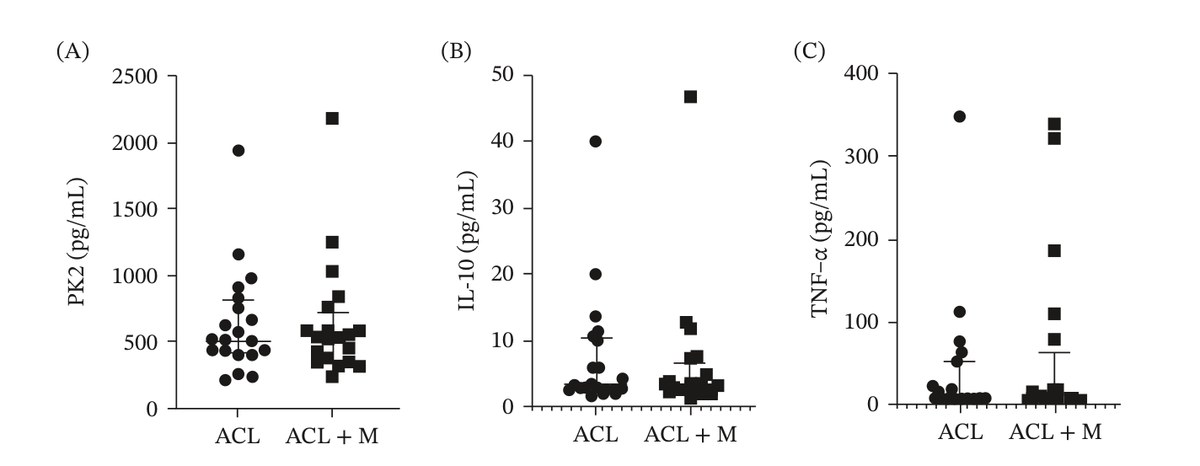
PK2 was detectable in all synovial fluid samples. However, no statistically significant differences in PK2 levels were observed between the ACL and ACL + M groups; similarly, IL-10 and TNF-α concentrations did not differ significantly. The authors had hypothesized that patients with combined ACL and meniscal injuries would exhibit higher PK2 levels due to the increased tissue damage, but the findings did not support this hypothesis. No significant correlation was found between patients’ gender, weight and height and the levels of the three cytokines analyzed.
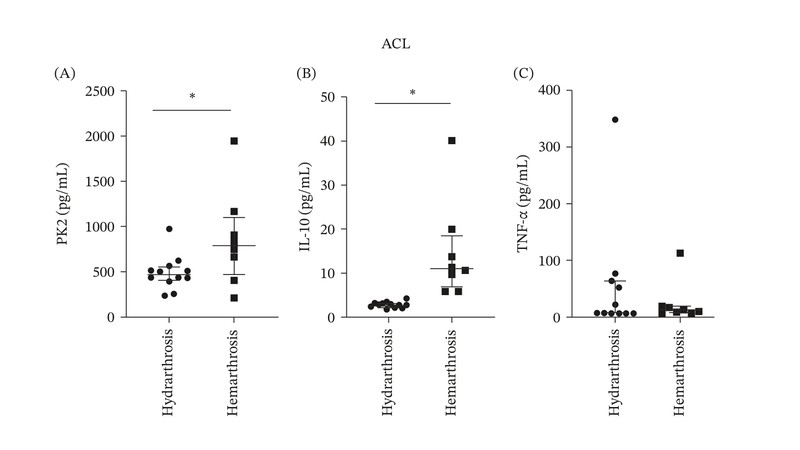
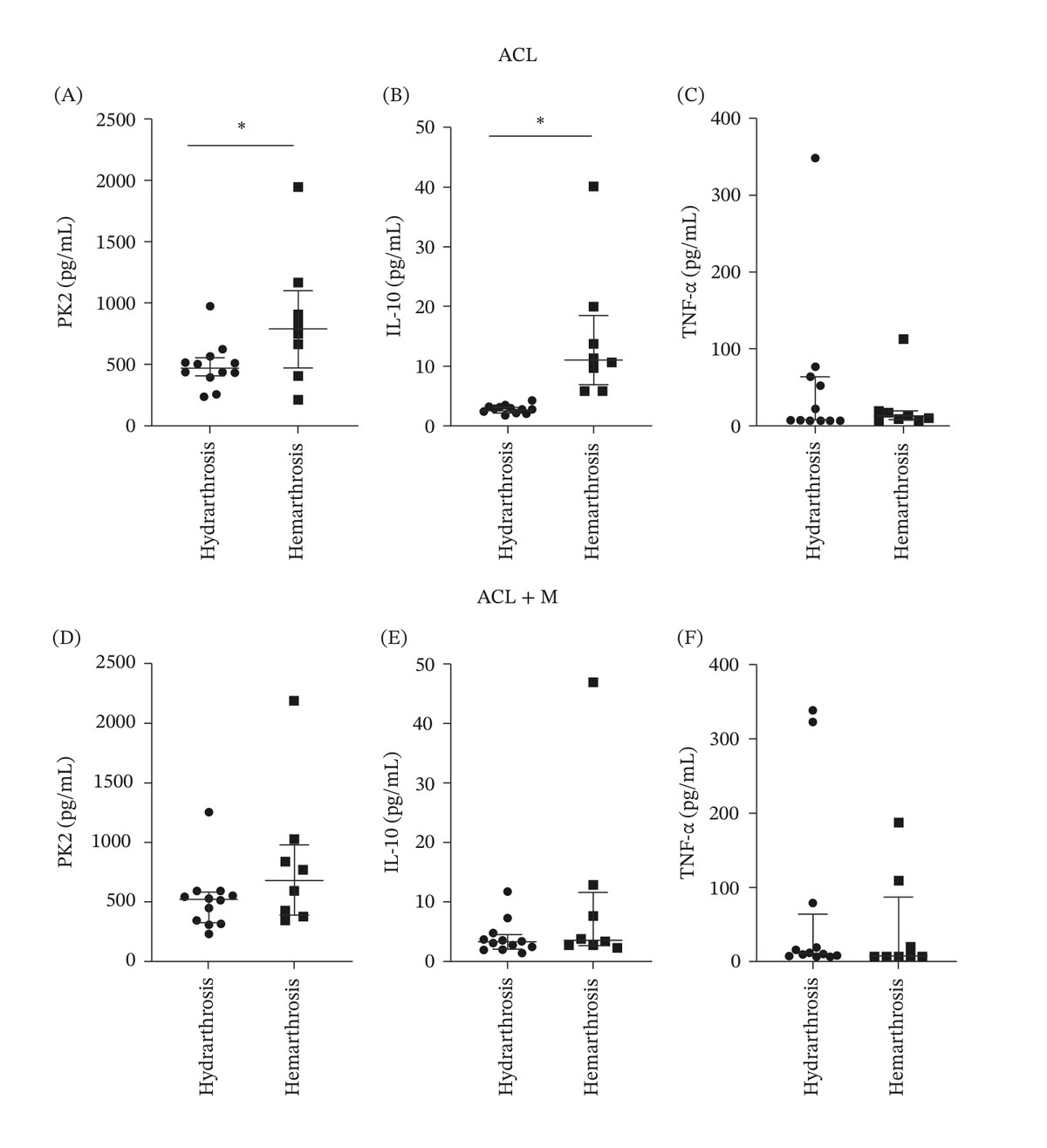
Compared with hydrarthrosis, hemarthrosis was associated with higher PK2 and IL-10 levels, whereas no statistically significant difference was observed for TNF-α. According to the authors, blood contamination may affect synovial fluid biomarker measurements and may partly reflect injury severity rather than a biomarker-specific inflammatory pathway: findings related to hemarthrosis should therefore be interpreted with caution.
When analyzed according to time from injury, descriptive data suggested a progressive decrease in PK2 and IL-10 levels and a possible increase in TNF-α levels from the acute to the chronic phase. However, time from injury was not significantly associated with PK2 levels, suggesting that PK2 concentrations may not follow a clear time-dependent pattern; this may be consistent with a sustained inflammatory process. In contrast, longer time from injury was significantly associated with lower IL-10 levels. After adjustment for group membership and synovial fluid appearance, this association was attenuated and showed only a borderline residual effect.
A significant positive correlation between PK2 and IL-10 was observed in the ACL group (r = 0.749), whereas no correlation was found in the ACL + M group. No correlation was found between TNF-α and PK2 levels in either group.
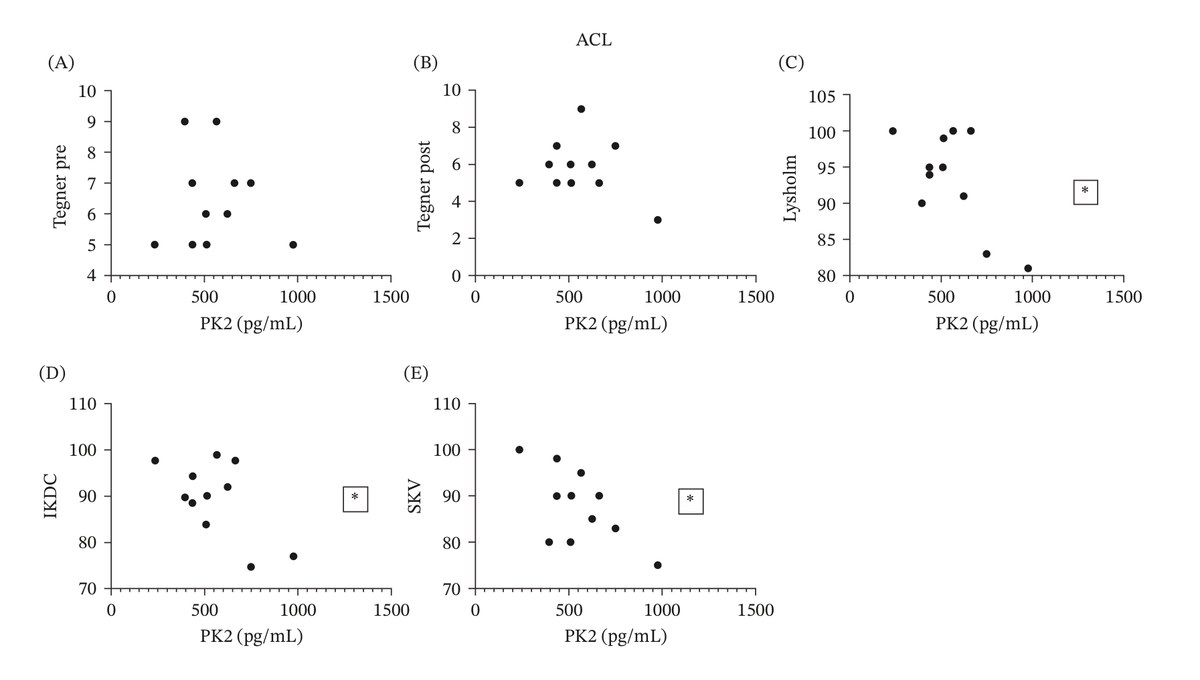
At the five-year follow-up, a significant negative correlation was found in the ACL group between baseline PK2 and Lysholm (r = −0.663), IKDC (r = −0.613) and SKV (r = −0.637): high initial PK2 levels were associated with lower PROMs scores. No correlation was found with the Tegner activity scale, and no association was found between PK2 levels and PROMs scores in the ACL + M group.
Conclusions
The study provides initial evidence of PK2 in synovial fluid following ACL injury: PK2 was detectable across different phases of injury. According to the authors, PK2 may represent a candidate biomarker involved in the post-traumatic inflammatory microenvironment.
The negative correlation between PK2 levels and IKDC, Lysholm and SKV scores suggests a possible association between higher early PK2 concentrations and poorer long-term clinical outcomes. This is consistent with the hypothesis that elevated PK2 levels may be associated with joint dysfunction through its proinflammatory effects and influence on pain perception. The role of PK2 in nociceptive sensitization is well established. Consistent with this, several animal models of OA have shown that the inhibition of the PK2 system with pharmacological antagonists can reduce local inflammation and tissue damage, restoring motor function and preventing pain development.
The authors acknowledge the exploratory nature of the study and its limitations:
- the relatively small sample size and the single-center design;
- the inherent variability of cytokine measurements;
- the difficulty of obtaining synovial fluid from healthy controls;
- follow-up based on clinical outcomes only, without a radiographic or MRI-based assessment of structural PTOA;
- heterogeneity in sampling context, as synovial fluid was collected either at initial presentation or intraoperatively during arthroscopy;
- possible residual confounding, as the limited sample size did not allow adjustment for all potentially relevant clinical variables, including rehabilitation protocol, time to surgery, baseline activity level and meniscal treatment characteristics.
Future longitudinal studies with larger sample sizes, radiographic or MRI-based structural assessment and mechanistic analyses are needed.
References
Crippa M, Franchi S, Rizzi L, Sacerdote P, Galimberti G, Antolini L, Piatti M, Portinaro N, Amodeo G, Zatti G, Torsello A, Turati M, Bigoni M. Role of Prokineticin-2 and Cytokines in Synovial Fluid in Traumatic Anterior Cruciate Ligament Injuries. Mediators of Inflammation, 2026:6435678, 2026. https://doi.org/10.1155/mi/6435678